- 1What is “gokito”?
- 2The Origins of Prayer Services
- 3Types of Gokito
- 4Prayer Service Procedure
- 5Prayer Etiquette & Attire
What is “gokito”?
How to read “gokito”
The reading is “gokitō”
“Gokito” is read as “gokito”.
Additionally, prayer services may also be called “prayer requests” (gokigan) or “purification rites” (oharai).
At our shrine, we explain that prayer ceremonies and prayer requests refer to rituals where wishes are conveyed to the gods together with the shrine priest, while “purification rites” primarily involve cleansing the mind, body, and surroundings.
Although the names differ, all are important Shinto rites where one faces the gods and offers prayers.
What does a prayer service involve?
A More Formal Method of Worship
While worship is an act where the worshipper personally conveys gratitude or wishes to the deity, prayer involves a Shinto priest formally performing rituals, reciting prayers (norito),and delivering the wishes to the deity.
In addition to the worshipper joining their hands in prayer, a prayer ceremony involves performing a series of rituals that are difficult for an individual to do alone, such as purification rites, chanting of prayers, and offering sacred branches, all conducted together with the priest.
Therefore, compared to regular worship, a prayer service provides an opportunity to approach the deity and offer prayers in a more careful and formal manner.
(Reference) Tokyo Metropolitan Shinto Shrine Association ‘Visiting Shrines and Prayer Services’
A means to have one’s requests heard by the deity
Priests serve as intermediaries between the deities and worshippers. They are, in essence, the bridge connecting us to the divine.
By going through the priest as this bridge, worshippers can convey their wishes to the deity in a more formal and respectful manner than if they were to make a request alone.
The most representative example of this is the [Noritosoujou (Recitation of Prayers)]. During the Noritosoujou, the Shinto priest recites the visitor’s wishes to the deity on their behalf.
Additionally, the Tamagushi Offering is a ritual performed according to formal etiquette when presenting wishes to the deity, serving as a vital act of offering prayers with sincere devotion.
Through these rituals, the shrine priest connects the deity and the worshipper, giving form to the prayer.
(Reference) Nagano Prefecture Shinto Shrine Association, ‘Shinto Shrine Terminology’
Who performs prayers?
People of all backgrounds
Originally, prayers were performed by a limited number of people involved in national politics and rituals, seeking the nation’s peace and prosperity and abundant harvests.
However, with the passage of time, this practice has changed, and today, anyone can receive prayers regardless of status or position.
For example, His Majesty the Emperor continues to perform prayers wishing for the peace of the nation, its people, and even the world. Meanwhile, not only those in official positions, but also ordinary people facing milestones or holding wishes in their daily lives perform prayers, each imbued with their own intentions.
In this way, prayer services have been passed down through the ages, changing form while remaining an important place of prayer connecting people and the divine.
From infants to the elderly
Prayers come in various forms, tailored to each stage of life, from infants to the elderly.
For example, shortly after birth, around one month old, there is the first shrine visit (Hatsumiyamairi) for infants, praying for their healthy growth.
For the elderly, there are prayers for milestone birthdays like the 70th (Koki) or 77th (Kiju), expressing gratitude for their life journey and praying for continued health and longevity.
Furthermore, prayers are not limited by age; they can be performed according to the season or situation. During New Year’s, prayers for household safety are offered.
At turning points in work or competitive endeavors, prayers for business prosperity or victory can be received, tailored to the specific wishes of the moment.
In this way, prayers serve as important opportunities to convey wishes and gratitude to the gods, accompanying people through life’s milestones and various everyday situations.
Which religion’s practice is prayer?
A practice of “Shinto”
Prayers performed at shrines are based on the religion of Shinto.
Shinto is a religion born in Japan and passed down only within Japan, developing as a faith that finds deities in nature and daily life.
In shrine prayers, the Shinto priest, who acts as an intermediary between the deities and the worshippers, formulates the worshippers’ wishes into a norito (prayer chant) and conveys them to the deities.
Thus, conveying wishes through the priest forms the fundamental process of prayers performed at shrines.
Prayers performed at temples are Buddhist prayers
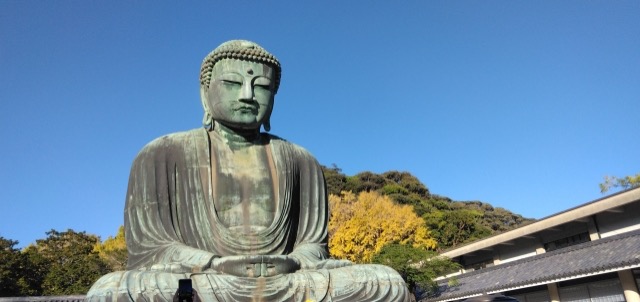
Temples practice Buddhism, and the deities enshrined there are Buddhas.
Buddhism originated in India around the 6th to 5th century BCE and spread as a philosophy aiming for enlightenment through teachings and practice.
In prayers performed at temples, monks convey the wishes of worshippers to the Buddhas. The central ritual is chanting sutras.
Depending on the sect, various practices are performed, such as the homa ritual using a homa altar, or using mudras, mantras, and wooden swords.
Thus, even though both involve “prayer,” shrines and temples differ in their religious backgrounds and ritual forms.
The Origins of Prayer Services
[Ancient Times to Nara Period] Conducted as State Rituals
Originally, prayers were performed not for individuals but for the nation.
Among these, prayers for “national peace,” “bountiful harvests,” and “stable weather”—prayers with a high degree of public significance—were performed at shrines nationwide, and the general populace was not heavily involved in these prayers.
[Mid-Heian Period Onward] Prayers for Individuals Emerge
From the mid-Heian period onward, individuals known as “prayer masters” (kito-shi), distinct from Shinto priests, emerged and began performing personal prayers for nobles and warriors. These prayers primarily focused on individual concerns, such as recovery from illness and warding off misfortune.
Later, entering the Meiji period, the nature of prayer ceremonies underwent significant changes under the influence of government religious policies such as the Separation of Shinto and Buddhism Decree and the Shrine Consolidation Decree.
This led to the establishment of the current form of prayer ceremonies conducted by Shinto priests.
Thus, prayer services have been passed down to the present day, changing form in response to shifts in the times and social systems.
(Reference) Shinto Shrine Association: ‘Prayers at Shrines’
Types of Gokito
Warding Off Misfortune
Warding off misfortune prayers are rituals where people pray to the gods to ward off disasters and evil, and to ensure peaceful and safe passage, particularly focusing on the “unlucky years” (yakudoshi) that occur at specific ages or life milestones.
It can be performed not only by those in their unlucky years but also by those not in their unlucky years.
Household Safety
This prayer seeks divine protection to purify and ward off misfortune, ensuring your family and home enjoy peace and health throughout the year.
The family is also the “smallest unit of society.” Unrest within the family can easily lead to instability in one’s own life. Why not consider receiving a prayer for household safety at the start of the year or the beginning of a new period?
Traffic Safety
This prayer asks the gods for safety during daily essential travel, whether using cars, motorcycles, or other vehicles, or for children commuting to school or adults traveling to work.
Modern transportation networks have greatly reduced the burden of travel.
However, in the past, especially during the Edo period, long-distance travel involved many dangers.
The traffic safety prayer is an ancient prayer filled with the earnest wishes of the people.
Safe Childbirth

This prayer expresses gratitude to the gods for the baby’s presence in the mother’s womb and asks for the health and well-being of both mother and child until the birth. Since ancient times, many have received this prayer to ensure a safe delivery.
Especially on days of the Dog (Inu) in the Chinese zodiac, many people visit shrines for safe childbirth prayers.Dogs are considered the “guardian deities of safe childbirth” because they are known for their prolific and easy births, making the day of the Dog an auspicious day for safe delivery.
(Reference) Santai Shrine ‘Safe Childbirth Prayer’
First Shrine Visit
The “First Shrine Visit” is a prayer ceremony where parents take their newborn baby to a shrine for the first time. They give thanks to the gods for the safe birth and pray for the child’s healthy growth.
Generally, it is customary for boys to visit on the 31st day after birth and girls on the 33rd day. However, the date should be chosen flexibly according to the health of the mother and child and the weather.
(Reference) Shinto Shrine Association ‘Shinto Rites Related to Childbirth and Childcare’
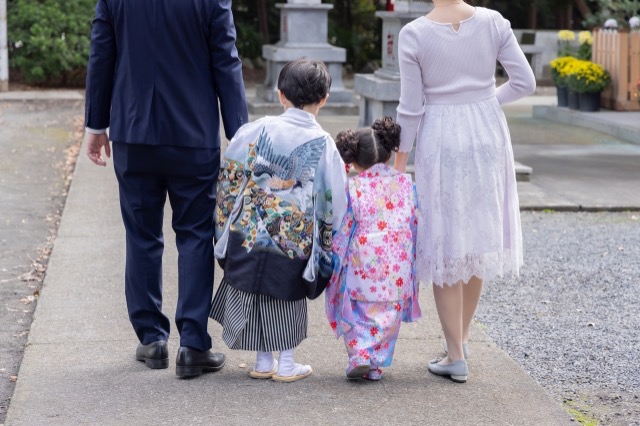
Shichi-Go-San
This is a prayer ceremony to thank the gods for the healthy growth of children reaching the milestone ages of 3, 5, and 7, and to pray for their continued safety and further growth.
While nutrition and sanitation have improved in modern times, infant mortality rates were high before that, making the very fact that a child grew up safely cause for celebration.
This is why the Shichi-Go-San prayer ceremony, celebrating children’s growth at specific ages, became established.
Generally, boys celebrate at ages 3 and 5, while girls celebrate at ages 3 and 7.
The 3-year-old ceremony is also called the Hair-Cutting Ceremony, the 5-year-old the Hakama-Wearing Ceremony, and the 7-year-old the Obi-Removal Ceremony, reflecting their role as rites of passage celebrating a child’s growth.
Business Prosperity
This prayer is offered to the gods by those engaged in business or commerce, wishing for the continued prosperity of their trade or enterprise and for good relationships with customers.
Many people receive this blessing at the start of the year or when embarking on new challenges.
Shinto shrines, particularly Inari shrines originally dedicated to praying for abundant harvests, have adapted their prayers to the changing times, broadening them to include “prosperity in one’s livelihood.” Today, many shrines prominently feature the benefit of “prosperity in business.”
Company Safety
Company Safety Prayer is a ritual where companies and workplaces pray for the safe conduct of business operations without accidents or disasters, and for the safety of their employees and staff.
Many companies receive these prayers at milestones such as the start of the year or the beginning of a new term.
Construction Safety
Construction safety prayers are prayers for accident-free and disaster-free progress at construction, civil engineering, demolition, and other work sites, wishing for the health of those involved, smooth progress of the work, and safe completion.
It may also be performed at the site in the form of a “groundbreaking ceremony.”
Other Prayers
Additionally, there are various prayers tailored to individual requests, such as academic achievement, protection from misfortune, and prayers for a good marriage.
The types of prayers offered vary by shrine, so contacting the shrine directly will allow them to guide you to the most suitable prayer for your request.
Prayer Service Procedure
Registration and payment of the offering fee
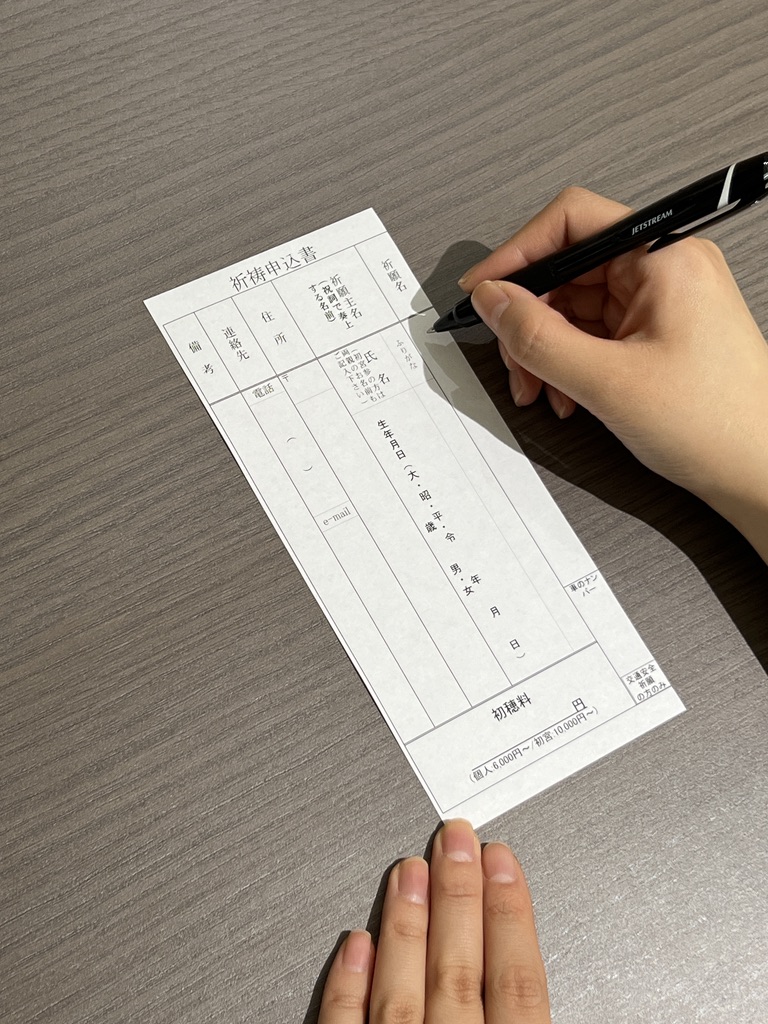
You can make a reservation in advance by phone or through the shrine’s website, or apply directly at the shrine. Be sure to check the application method for the shrine you plan to visit.
The offering fee is paid at this time. If you require a receipt, please request one and it will be provided.
The fee paid to the shrine for prayers is called the “offering fee” (hatsuhōryō).
This originates from the ancient practice of offering the first rice ears harvested that year (hatsuhō) to the gods. Over time, this evolved from rice to cash.
(Reference) Shinto Shrine Association: “Etiquette for Hatsuhōryō and Tamagushi Fees”
Wait in the Waiting Area
Wait for your turn in the prayer waiting area.
The shrine staff will guide you, so please wait inside the waiting area whenever possible so you can be called immediately.
Proceed to the Worship Hall
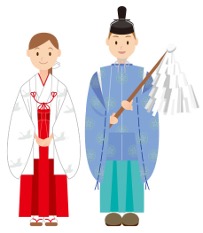
The shrine priest or shrine maiden will guide you to the worship hall.
From here onward, you are in the sacred presence of the deity, so proceed with a calm heart.
Purification Ritual (Shubatsu)
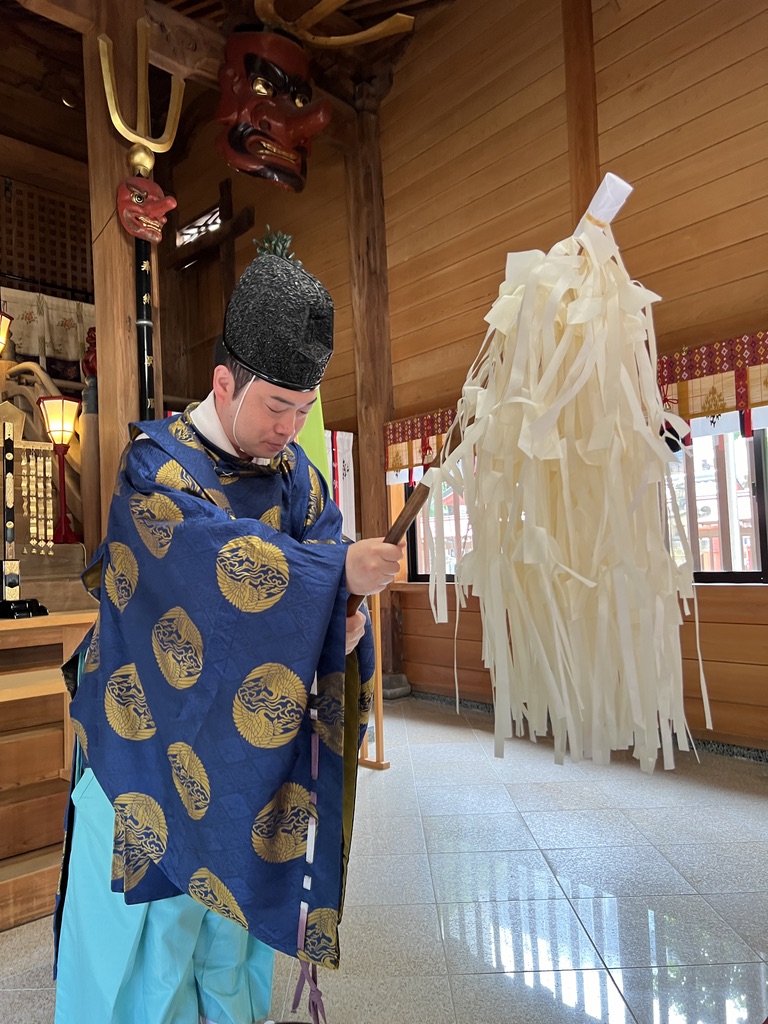
The Shinto priest recites the purification prayer and performs the purification rite.Using a purification tool called the o-nushi, they perform the purification rite on the sacred items and the participants.
Recitation of the Norito
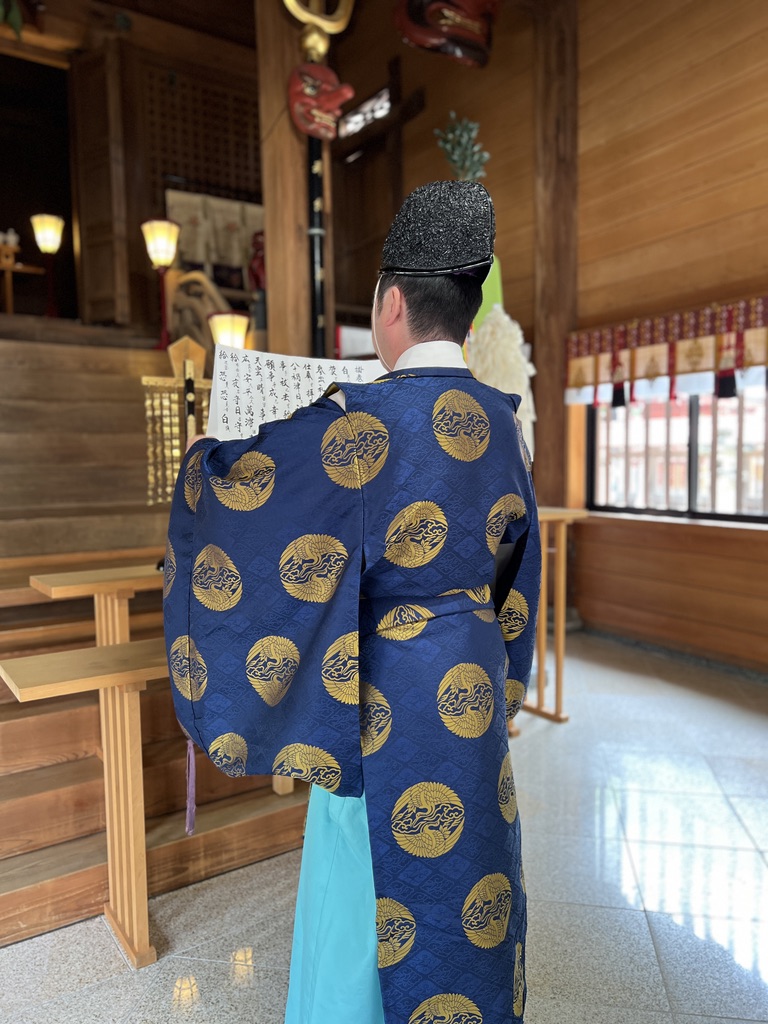
The Shinto priest recites prayers for the fulfillment of the worshippers’ wishes.Different norito are used depending on the nature of the wish, and they are primarily written in Yamato words.
Yamato words refer to words unique to Japan, excluding Chinese loanwords and foreign words.
Therefore, if you listen closely to the words recited by the Shinto priest, you may sometimes grasp the meaning of the words.
Offering of Sacred Branches
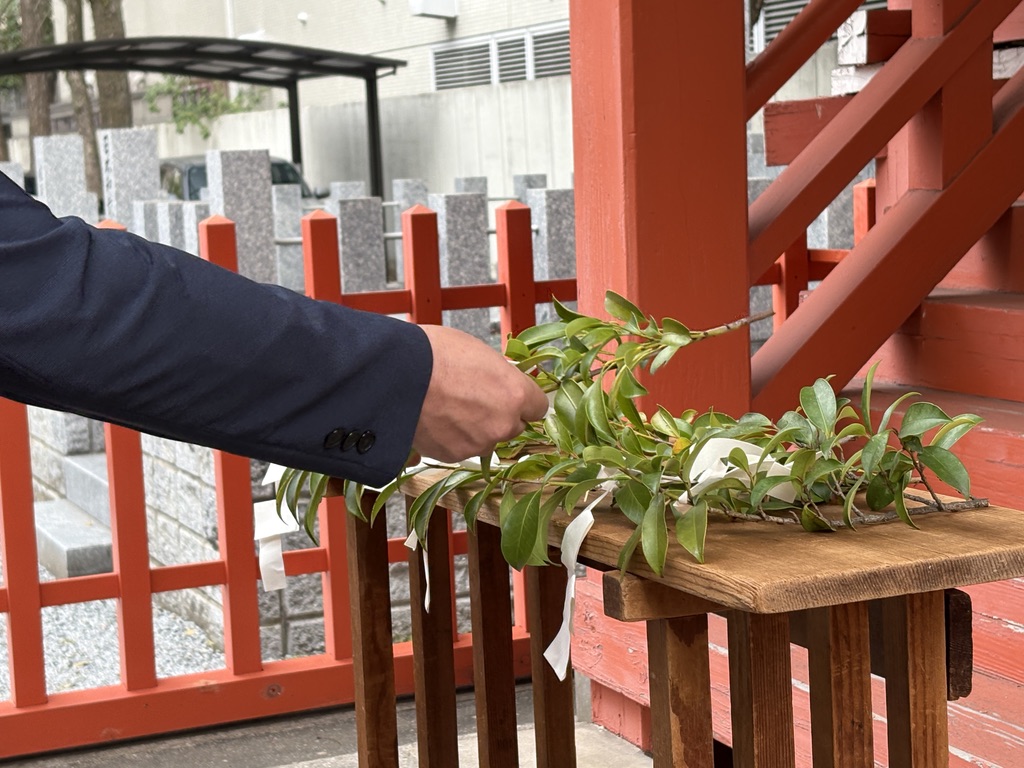
A small branch of sakaki, called a tamagushi, is offered to the deity.
- Receive the tamagushi from the priest and proceed to the altar table.
- Rotate the tamagushi clockwise so that the base faces the sacred altar.
- Place it on the table to offer it.
- Perform the ritual bowing: two bows, two claps, one bow.
Receiving the Granted Items
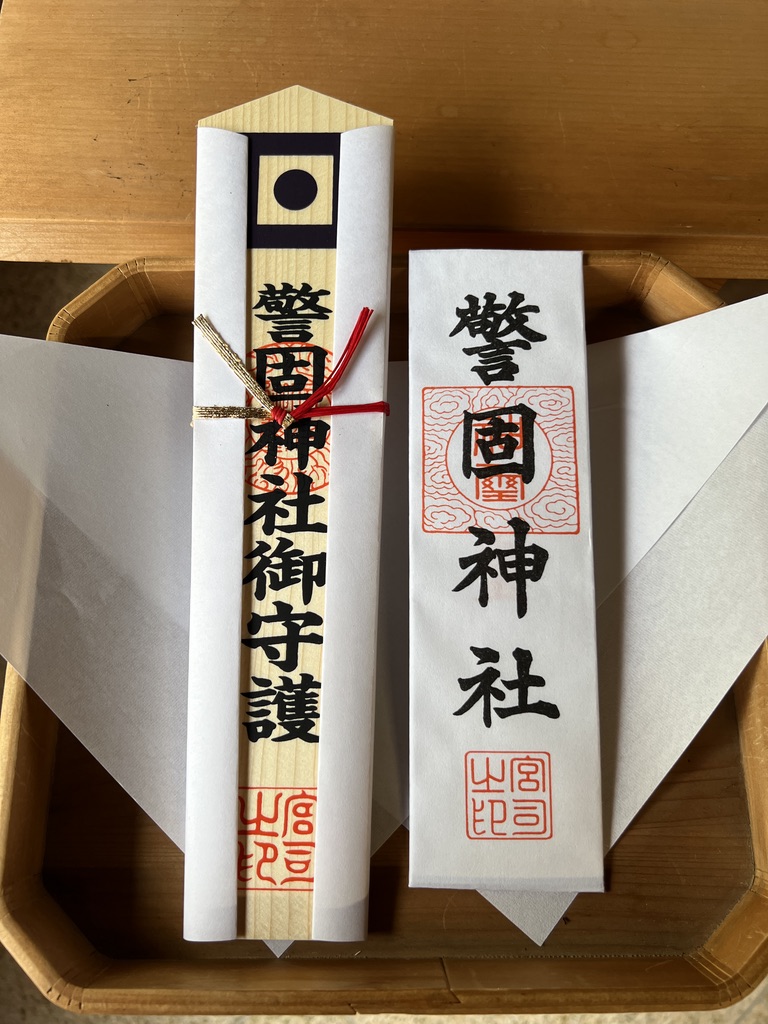
Place the talisman on a household shrine or in a clean place higher than eye level.
It is customary to place it facing east or south.
Please carry the amulets with you whenever possible.
Additionally, items such as sacred sake should be consumed as soon as possible, with gratitude toward the deity.
(Reference) Kego Shrine ‘Prayer Process’
Prayer Etiquette & Attire
Formal attire is preferred; keep casual wear to a minimum.
【Men】Shirts, jackets, simple sneakers or leather shoes, etc.

When facing the deity, Shinto priests dress formally, maintaining the same level of neatness and respect as when interacting with superiors. When we receive prayers,we should also aim for calm, appropriate attire befitting the sacred space before the deity.
Attire suitable for the workplace, such as shirts and jackets, is also appropriate before the divine presence and will not be considered disrespectful to the deities.
Avoid casual footwear like sandals; opt for leather shoes or simple sneakers with minimal decoration.
【Women】Simple dresses or shirts in light colors

Opting for monochrome or pale colors over vibrant hues helps minimize a casual impression, ensuring your attire feels appropriate and unobtrusive before the divine presence.Specifically, choose attire suitable for formal occasions, such as dresses or shirts, and aim for a composed appearance.
Prayer Etiquette
Set your cell phone to silent mode
Set your mobile phone to silent mode in advance or turn it off completely to prevent any sounds from occurring.
If a ringtone sounds during the prayer ceremony, it not only disrupts the solemn atmosphere before the shrine but is also disrespectful to other worshippers.
Please take great care to avoid this.

Confirm Photography Rules
Photography during prayer services is generally discouraged.
Photography may disturb other worshippers and could also be seen as disrespectful to the deity. In particular, refrain from taking photos in the prayer area or directly in front of the shrine.
Additionally, policies regarding hiring professional photographers vary by shrine.
If you wish to take photos, it is essential to confirm with the shrine in advance.
Prepare an offering fee
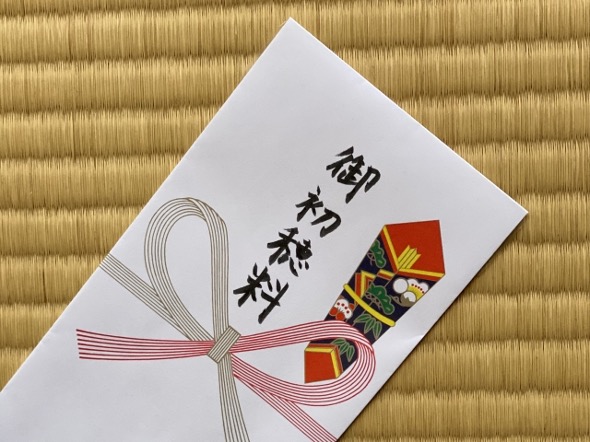
While it is acceptable to simply present the first harvest offering directly to the shrine, placing it in an envelope is a more polite form of presentation.
When using an envelope, write “First Harvest Offering,” “For the Divine Presence,” or “Sacred Branch Offering” on the front. There is no need for a special envelope; a standard gift envelope sold at convenience stores is perfectly acceptable.
(Reference) Tokyo Shinto Shrine Association: ‘How should the front inscription on an envelope be written?’
Confirm whether reservations are required
The method for accepting prayer requests varies by shrine.Some require advance reservations by phone or website, others only accept same-
day applications, and some accommodate both advance reservations and same-day requests.
Additionally, prayer services may not be available on days when major ceremonies are being held. It’s best to confirm in advance how the shrine you plan to visit handles reservations for peace of mind.